Why MPC + TEEs Are Becoming a Popular Custody Stack
They solve different security problems, but they complement each other.
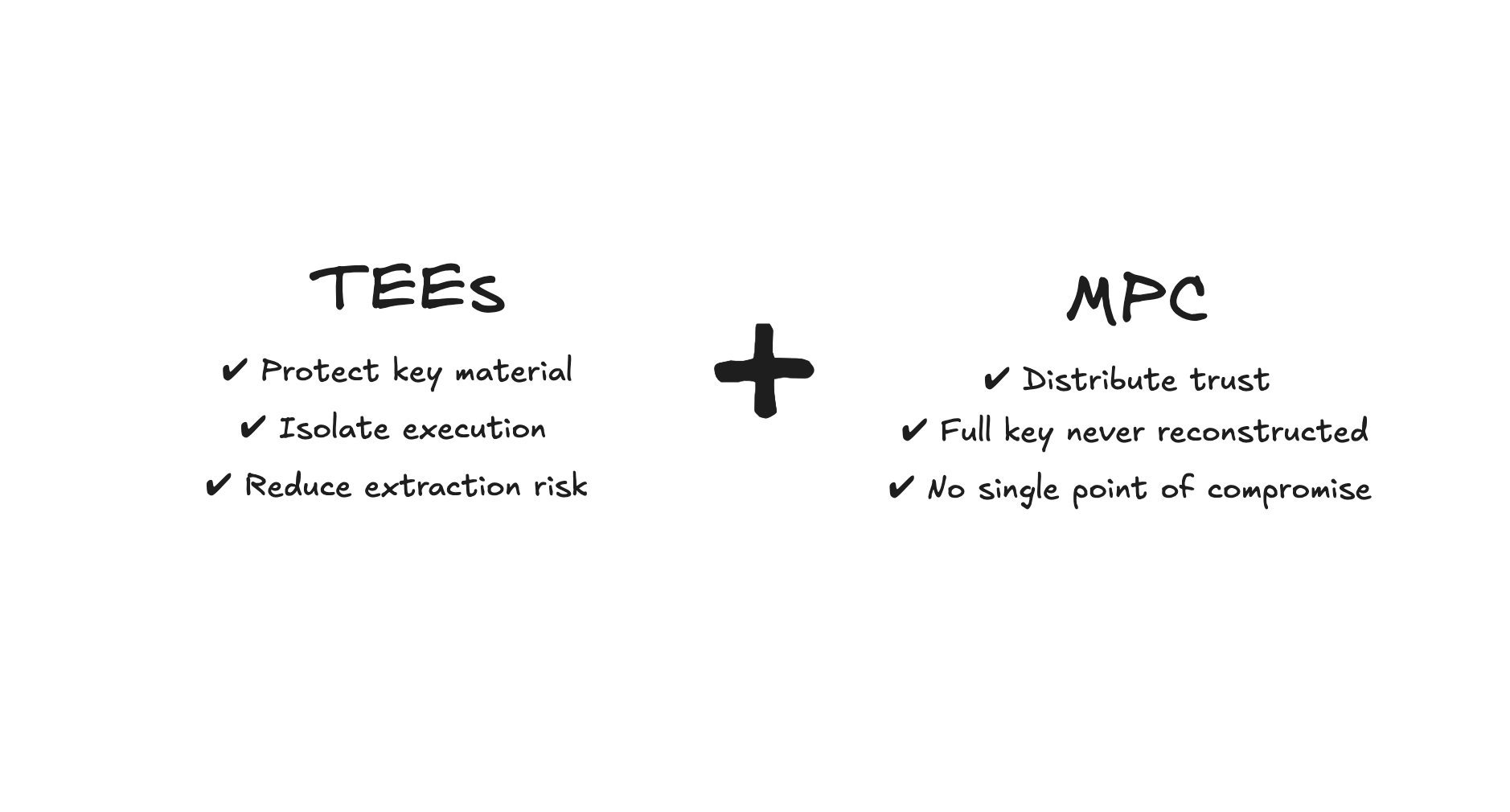
Trusted Execution Environments (TEEs) isolate your process and its data from the rest of the system. Even if the operating system is compromised or an administrator has root access, the private key material inside the TEE remains isolated and harder to extract.
But TEEs do not remove single-party risk. A compromised administrator can still influence what the enclave is asked to sign. Full-key backups improve recoverability, but they also introduce another copy of the key that an attacker only needs to steal once.
Single-party risks are what Multi-Party Computation (MPC) can protect against.
Instead of storing a single private key, MPC distributes cryptographic key shares across multiple independent parties. Full keys are never reconstructed, and no single server or party can authorize a transaction on its own.
MPC and TEEs Protect Different Layers
TEEs harden each signing node against compromise. They are valuable when you need cryptographic isolation between sensitive signing logic and the host operating system, cloud administrator, or application runtime around it.
MPC removes single points of compromise and single points of failure. It makes custody depend on a quorum of independent participants rather than a single private key, a single server, or a single administrative domain.
Put together, the custody model becomes stronger than either component alone: each signer is harder to compromise, and a compromised signer still should not be enough to move assets.
What Custody Stack Are You Using?
The right custody architecture depends on your assets, signing workflows, recovery requirements, regulatory obligations, and operational model. MPC and TEEs are not interchangeable controls; they address different parts of the threat model.
For high-value digital asset systems, that distinction matters. Strong custody design should reduce the chance that one machine, one backup, one administrator, or one compromised service can become the failure point.